Extraterritoriality in simultaneous interpretation
In a conference setting, a simultaneous interpreter will often work from an sound-dampening booth adjacent to the meeting space. The booth where Reggie sits in the movie Charade is typical—which is to say, quite literally, that it fits the type (or the image?). Reggie’s booth offers her a clear view of the speakers. From here, she listens to the source-language speaker through headphones and provides an oral translation, spoken into a microphone and likewise transmitted through headphones to her target-language audience.
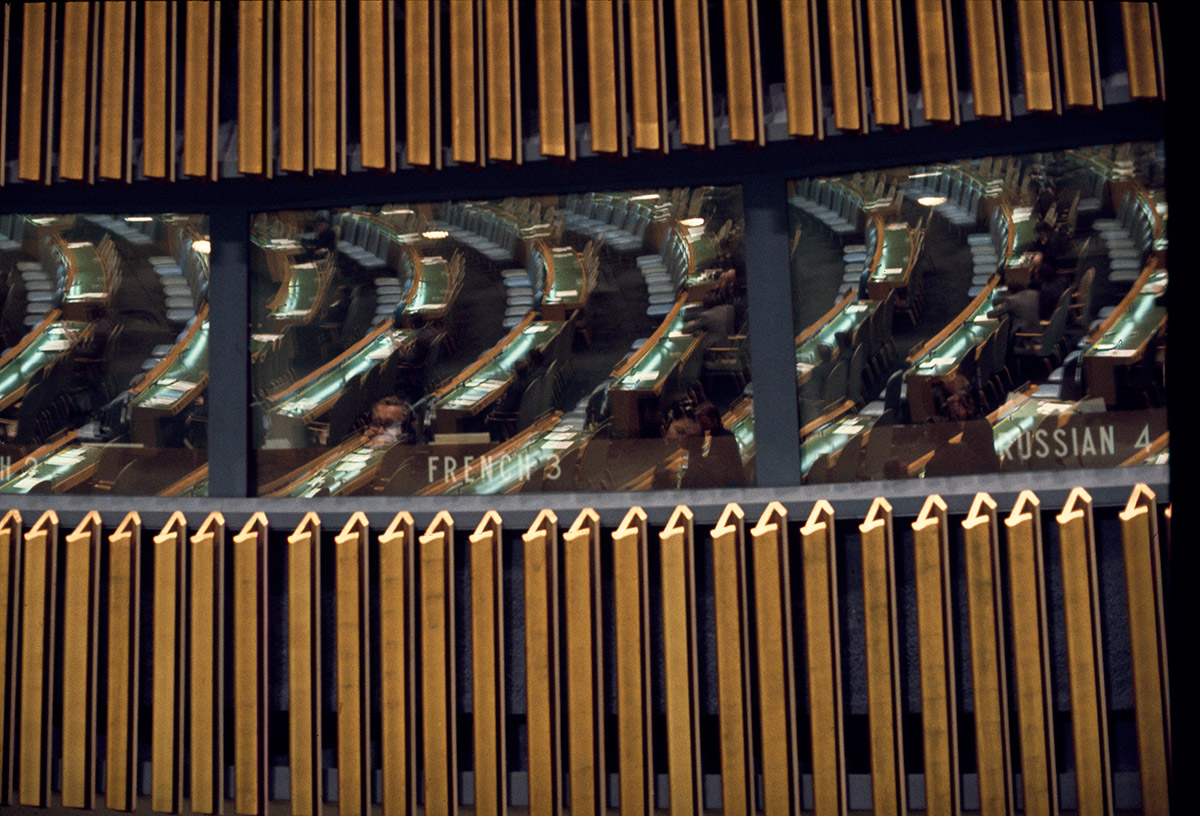
The General Assembly hall at the UN headquarters in New York City1–2 provides the most recognizable image of this context for simultaneous interpretation—justifably so, as it was probably one of the earliest spaces purpose-built for this method of translation. Earlier experiments in conference interpreting, specifically during the Nuremberg trials (1945–1946) and then at the provisional UN headquarters in Lake Success, New York (1946–1951), had resulted in a clear set of spatial requirements and procedural guidelines that were encoded in the architecture and design of the General Assembly hall.3
In this space, simultaneous interpreters work from two stories of booths built out from the curved walls on either side of the hall. As with other similar booths, their primary purpose is, ostensibly, to provide sound-proofing, but here the booths seem frozen in orbit around the assembly floor. They occupy a meta-architectural space, suspended in an intermediary position, both (neither?) within and (nor?) outside of the hall. The booths are forced into an extraterritorial position, a cluster of satellites from which to receive and transmit signals.
But even while the position of the booths serves to isolate the interpreters from the assembly floor, it also makes them more visible. Their elevation grants them a privileged vantage point while simultaneously making their presence even more conspicuous. To mitigate the interpreters’ hypervisibility, the interior lights of the interpretation booths are generally kept dim, but this only further complicates their relationship to the assembly floor. The brightness differential effectively turns the booth windows into mirrors, creating a panopticon-like condition of constant—if only presumed—surveillance over the assembly floor.1
This lighting differential is reversed in the 2005 film The Interpreter, whose main character—once again a simultaneous interpreter, a woman, and a natural polyglot with an international education—returns to her booth in the General Assembly after hours, when then lights are dimmed throughout the hall.4 While there, she overhears a conversation happening in secret on the darkerened assembly floor and being inadvertently transmitted to her booth via her headset.5 Just as she begins to understand that the conversation concerns an assassination plot, she accidentally switches on the lights inside her booth, drawing the attention of those on the floor. She’s not sure if she has been recognized, but the very uncertainty of her discovery by the would-be assassins injects the film with dramatic tension.
All of this suggests that this extraterritoriality is very intentional, and that it serves many purposes that go well beyong the isolation of sound. The significance of this extraterritorial position (socially, politically, spatially) is more obvious when considered alongside another form of simultaneous interpretation: chuchotage. Taken from the French word meaning ‘whispering,’ this form of translation relies on the interpreter having immediate access to the listener and speaking directly into the listener’s ear in a low voice.6
The proximity of its interpreters to those in power, or their existing membership within a privileged class, was apparently a concern in the UN, which in the 1960s shifted from employing natural polyglots—often from families with diplomatic or military connections—to using trained interpreters.
Socially as well as physically, interpreters were moved further from the speakers and listeners, and deeper into an extraterritorial position.
Next:
1 ↓
2 ↓

3 Baigorri-Jalón, Jesús and Kayoko Takeda, editors. New Insights in the History of Interpreting. John Benjamins Publishing Company, 2016, pp. 170–186.
4 The Interpreter. Directed by Sydney Pollack, performance by Nicole Kidman, Universal Pictures, 2005.
5 ↓

6 ↓
