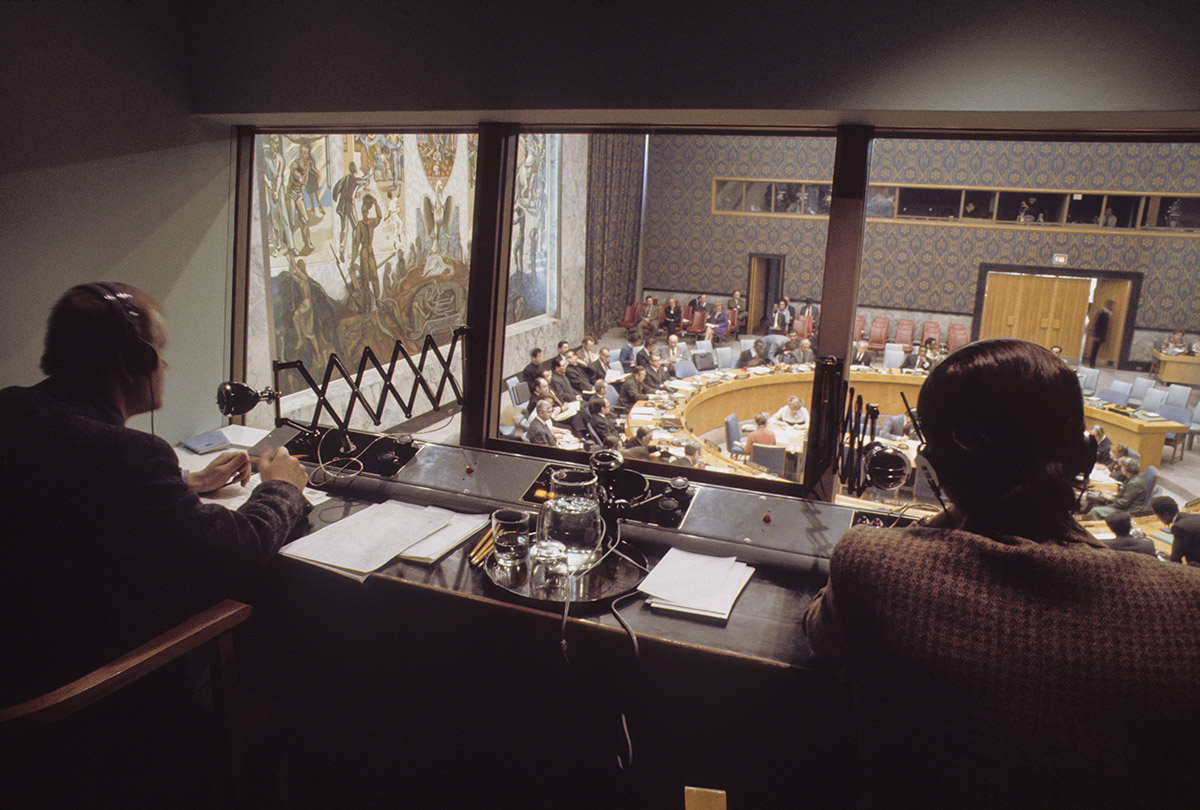
An image of simultaneous interpretation
Regina Lampert, the lead character in the 1963 comedy-suspense-thriller Charade, works as a simultaneous interpreter.1 Or at least she did at one time, prior to having married a wealthy Swiss man—he’s killed off before the opening credits—and she does again, for at least part of one day within the film’s timeline, because as a widow she’s “not a lady of leisure anymore, you know” (her words).
But it’s hard to believe that Reggie, as she’s called, has ever relied financially on her skills as a French-to-English interpreter. She has no real conception of money, and there’s a passive ease to the way she navigates her life of skiing holidays in the Alps, Louis Vuitton luggage, and Givenchy dresses (she wears nothing but). Her character seems scripted precisely to parody the boredom of the perpetually wealthy.
We could reasonably guess that Reggie came to the profession almost by default. Working as a simultaneous interpreter probably fit within her existing skill set—maybe she, like the actress portraying her, was raised in an international, multilingual, aristocratic family—and maybe she recognized that the job would offer some cultural continuity for her, surrounding her with politicians, businessmen, and academics while she waited for a marriage proposal.
Only once, and quite late in the film, do we actually see Reggie working as a simultaneous interpreter. The scene opens with an exterior shot of what amounts to an ersatz UNESCO. The shot shows the organization’s actual Paris headquarters, recast here as E.U.R.E.S.C.O. with an imposing black-and-silver sign planted on the front lawn.2
The interior is a similarly transparent approximation of an early UN conference room.3 The simple room is furnished with rows of desks and leather chairs, each place marked by a placard stating a delegate’s nationality and outfitted with a microphone and wired headset. Reggie and her fellow interpreters sit in glass-windowed booths at the back of the room, and from here they listen to the proceedings and provide live interpretation in their respective target languages.
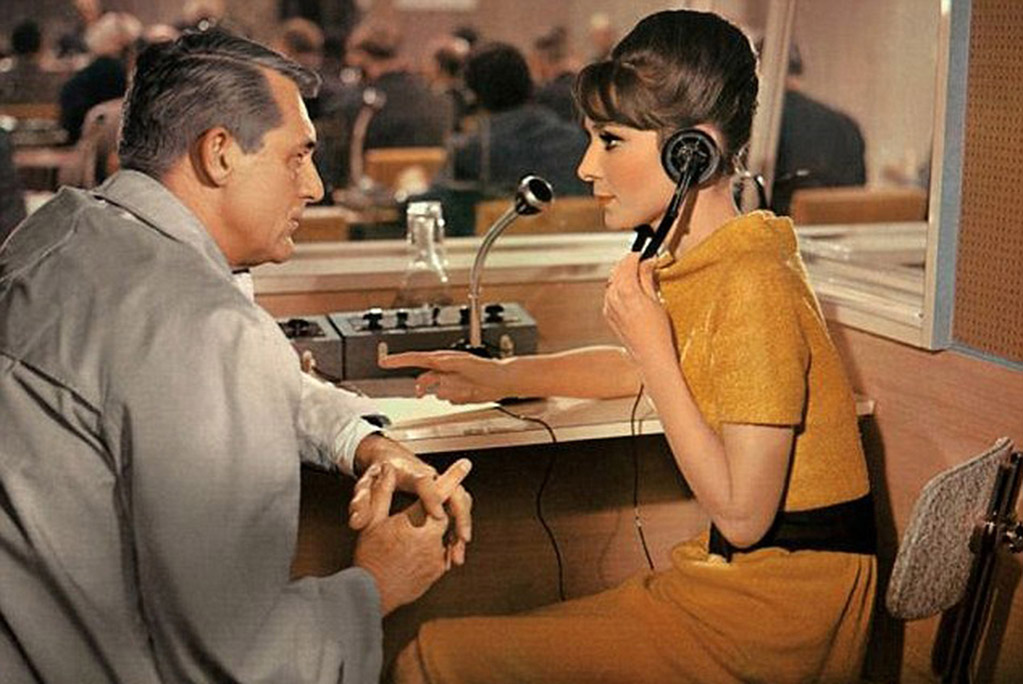
On the desk inside Reggie’s booth we see a similar microphone, headset, and basic control unit.4 (Reggie—improbably? predictably?—wears the headset upside down, holding the headband with one hand under her chin, to protect her hair from being dented. As always, she is dressed in Givenchy.) There’s little else on her desk apart from a notepad and a carafe of water. The wall paneling is split in the middle, plain wood below, and above it a perforated material—maybe cork?—that appears abstractly functional and at any rate is probably meant to be “read” as sound-dampening.
The setting for this scene isn’t significant to the dialogue or its narrative purpose in context of the broader plot development. Its significance is instead to reinforce the general image of Reggie’s character. That is, her employment as a simultaneous interpreter is a signifier of her sociocultural identity as a native polyglot and the beneficiary of a privileged, internationalized education. But as much as Reggie’s employment reinforces her sociocultural identity, her character’s sociocultural identity also reinforces a collective image of the simultaneous interpreter.
The film creates an image of Reggie’s occupation that mirrors at every level the actual context in which professionalized simultaneous interpretation developed, including its sector (intergovernmental conferences), its architectural setting (glass-windowed booths), the primary languages used (English and French), and the demographics of the interpreters (natural polyglots, often from families with government or military connections). Even where this image might prove reductive in its simplicity, its existence in collective consciousness reflects the role of language to identify and name.
(An aside(?): Throughout the film, the names of the individual characters are reiterated incessantly—absurdly? comically?—in their dialogue with one another. This serves an important narrative function, because much of the plot is driven by mystery surrounding the real identities—the real names—of the main characters. Characters undergo multiple transformations, changing from one identity to another, and which each shift a new name is revealed. Reggie is situated at the middle of this mystery, forced to interpret and reinterpret her context as new identities unfold around her.)
Thus equipped with an image of simultaneous interpretation...
Next:
1 Charade. Directed by Stanley Donen, performances by Audrey Hepburn and Cary Grant, Universal Pictures, 1963.
2 ↓

3 ↓

4 ↓
5 ↓